Across campus, the air is filled with the hum of study groups, relentless tapping of keyboards, and of course the neverending construction work. But in one place you can step away from the noise altogether.
Finn Agerkvist, associate professor and leader of our Acoustic Technology group has the key to a room, where sound doesn’t travel.
“We use the room to make extremely precise sound measurements, where we need to ensure that there are no disturbing reflections” Finn explains.
An anechoic chamber – also known as a dead room – is designed to eliminate all forms of sound reflections and external noise. Here, sound dies instantly instead of being reflected back from the walls, floor and ceiling as it does in regular rooms.
This is how the dead room gives us the opportunity to measure the exact sound emitted from a noise source.
Here, researchers have, among other things, recorded individual instruments from a symphony orchestra and then assembled them virtually in a digital concert hall, where the sound can be experienced from different seats.
The space has also been used to test acousto-optic measurement methods, where researchers investigate how sound affects light to obtain precise measurements of acoustic waves and vibrations.
An echo without end
Before Finn opens the door to the dead room, there is another stop on the way, you see its counterpart is also found at DTU Electro.
In a cold, enclosed room with raw concrete walls and stretched plastic sheets, researchers have created an environment where sound does not disappear – it lingers, as if the room refuses to let it go.
When Finn claps in the reverberation room – or echo room – the sound becomes lingering, sharp and almost overwhelming. It bounces back and forth between the walls in a reflection that doesn't stop as you'd expect. The longer you stay in the room, the more it feels like the sound is pressing in.
"In here, the sound doesn't die immediately, but keeps reflecting back and forth. The reverberation is extreme because the walls are designed to maximize reverberation and delay the natural decay of sound," Finn explains, his words sounding unnaturally loud and insistent between the polished concrete walls.
The sound is so insistent that you unconsciously pull yourself towards the door to avoid the eternal echo in the room.
The sound of silence
If the echo room makes you step back, the opposite experience awaits you in the dead room.
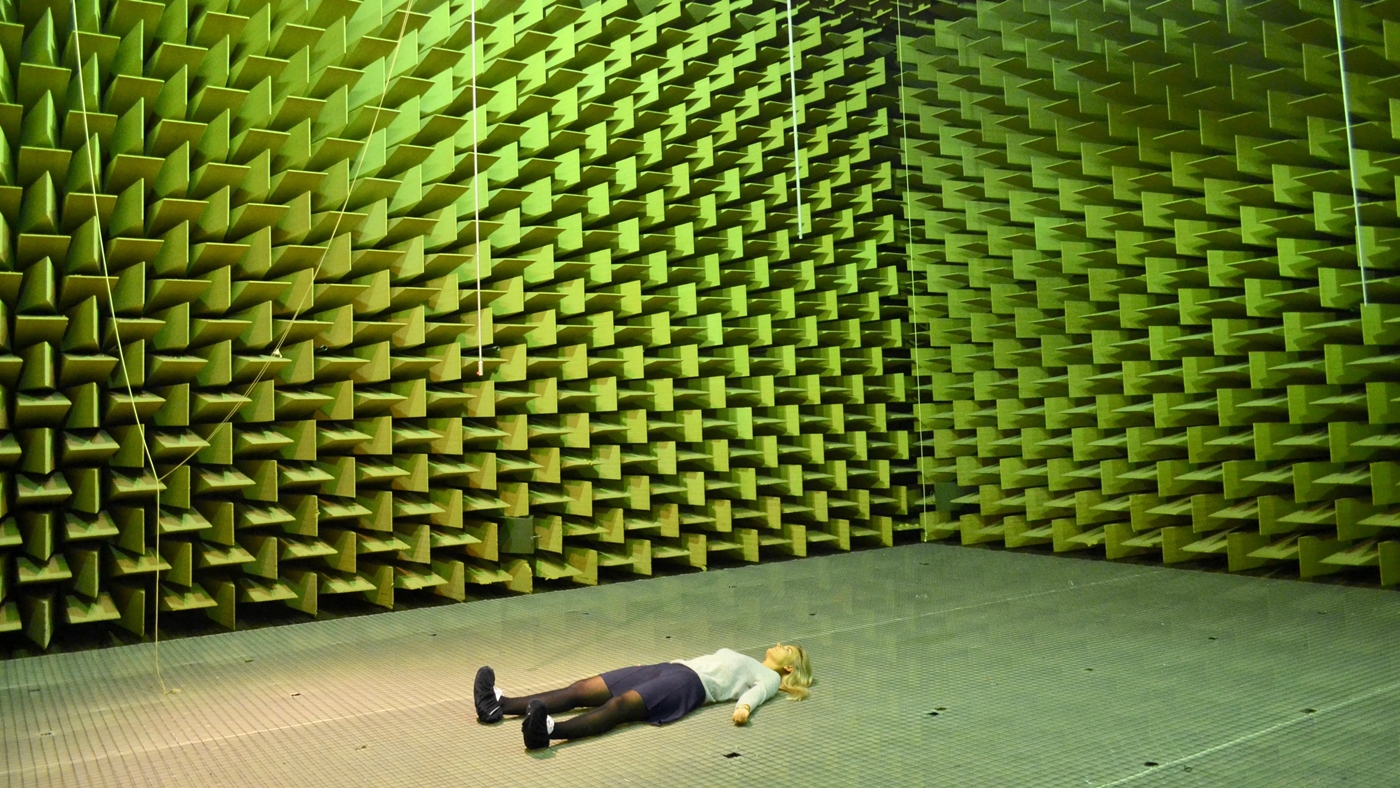
The room is an impressive construction: a 10 x 8 x 12 meter box, where you step out onto a fine-meshed net, so that you almost float between the floor and the ceiling.
Below and above you are walls covered with foam wedges that absorb all sound. Here there are no reflected sounds – only an emptiness that swallows everything.
“The wedges are designed to break up the sound waves and absorb them completely. If the surfaces were flat, the sound would be reflected back into the room, and then we wouldn’t get the total sound absorption that is necessary for accurate measurements,” Finn says.
If he turned his back to me, I would have a hard time hearing him, because nothing would throw the sound back at me. It would die as soon as it hit the wall.
He continues: “The change from air to material is what creates the reflection, and in the construction of the anechoic chamber we’ve created a gradual transition from air to material, which means that there is even less reflection”.
Finn claps his hands to illustrate the difference between the two rooms. Where the echo room bounced the sound around between the hard walls, here the sound dies instantly. No echo, no reverberation – just silence.
It gives your ears a strange sensation when you can hear your own blood, and Finn recognizes that.
"When you spend an entire afternoon in here, you might need to go outside afterwards," he says.
If you shut the door and are alone in the room, the experience changes. The silence is not just the absence of sound – it becomes a kind of noise in itself.
The only thing left is the body. Sounds, that would normally drown in the background noise of your surroundings, are now clearly coming through. The blood rushes in your ears, your jaw is cracking faintly, you start noticing your own pulse.
Words, clapping and other sounds, you can generate, disappear into the soft walls, and the only thing that lingers, is the feeling of being alone in a muted world – trapped with the sounds you can never escape from. Even if you raise your voice, it seems strange. A scream in an anechoic chamber is not reflected back; it dies, before it ever really travels.
Back into the noise
When you step bac out onto campus after staying in the dead room, the study groups, the traffic, and the eternal digging seem extremely loud. Noise is thrown back and forth between the buildings, and a mathematical discussion fills one of the long, naked halls.
Following a stay in complete silence, the acoustics of your surroundings feel profoundly different. Sounds you’d normally ignore, cut through more sharply. At DTU Electro both silence and noise are studied scientifically – one to measure its pureness, the other for its inevitable presence.
In the echo room, the sound never ends. In the dead room, it dies immediately. But outside the rooms, in the real world, sound is a constant – as a background we rarely notice, before it suddenly falls silent.