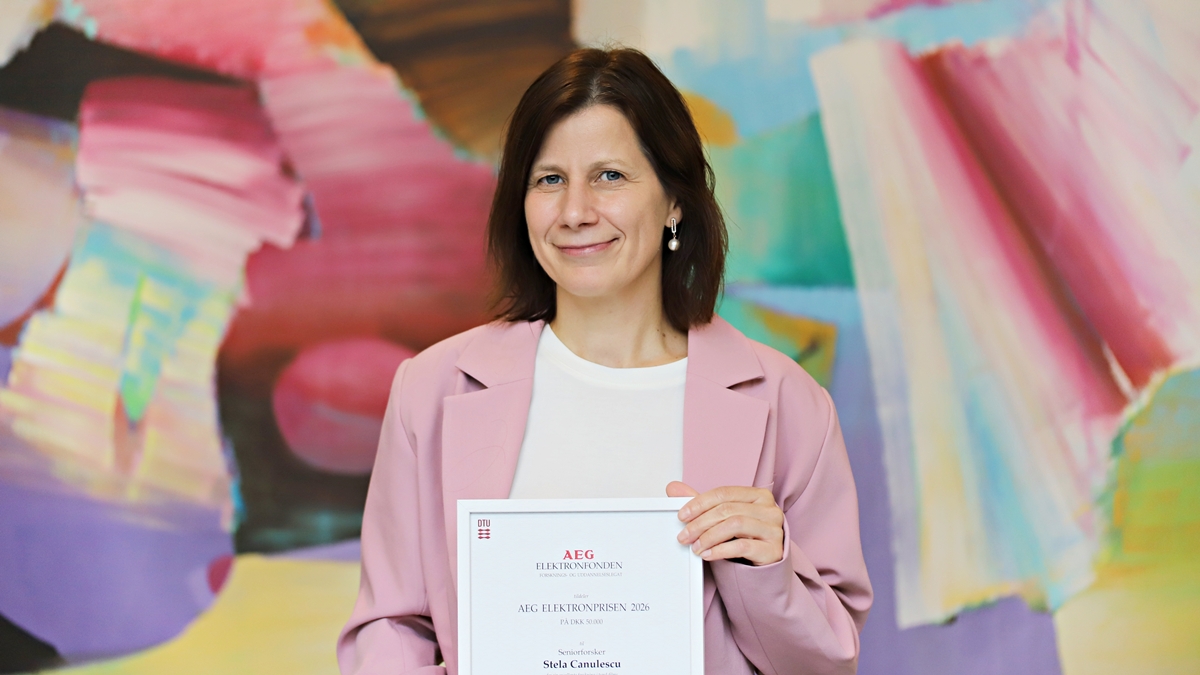
That is one of the possibilities being explored through the research of Senior Researcher Stela Canulescu at DTU. Her work on the fundamental properties of thin-film materials for solar cells has earned her AEG Elektronprisen 2026, an award that recognises and promotes technical and scientific development within the electrotechnical field.
For Stela, the award is recognition of research that begins at the most fundamental level: understanding what happens inside materials.
Looking closely at the boundaries
Thin-film solar cells are made from layers of semiconductor materials that can be extremely thin. Their small size makes them attractive for applications where conventional solar panels are too large or heavy.
But making these materials perform efficiently requires a detailed understanding of what happens at the microscopic level.
One of Stela’s research focuses is grain boundaries – the interfaces where individual crystalline regions within a material meet. These boundaries can affect how efficiently a solar cell converts light into electricity, because they can contribute to the loss of charge carriers before they can be used to generate electrical current.
By understanding and controlling these microscopic processes, Stela and her colleagues work to reduce energy losses and improve the performance of thin-film solar cells.
Another important part of her research is optimising the band gap of semiconductor materials. The band gap determines which wavelengths of light a material can absorb and how efficiently that absorbed light can be converted into electricity.
Together, these approaches can help push the efficiency of thin-film solar technology further.
Solar cells that go beyond the rooftop
The potential applications are significant.
Because thin-film solar cells can be made much smaller and lighter than conventional solar technologies, they could open up new possibilities for integrating solar energy into products and environments where traditional panels are impractical.
And their potential does not stop outdoors.
Some of the materials Stela works with can be designed to perform efficiently under low-intensity indoor light, including light from LEDs. That could make them useful for powering small electronic devices and sensors indoors, reducing the need for batteries or wired power.
In other words, solar technology could become something we integrate into everyday objects rather than something we only associate with rooftops and solar farms.
From fundamental science to real-world impact
Although Stela’s research is fundamentally focused, its potential applications are broad.
This connection between understanding nature at a fundamental level and using that knowledge to improve life and society is at the heart of the research taking place at DTU Electro.
By investigating how electrons, light and materials interact at microscopic scales, Stela and her team can uncover new ways of controlling these processes – and ultimately use them to address challenges in the real world.
For Stela, this also extends beyond her own research.
Alongside her scientific work and teaching, she has a strong ability to attract and collaborate with talented researchers, helping to build an environment where new ideas and expertise can flourish.
Powering the future
The transition to a society powered by renewable energy will require more than simply deploying more solar panels. It will also require new materials, new technologies and new ways of generating and using electricity.
Stela’s research could contribute to that future by making solar cells more efficient, lighter and adaptable to new environments.
AEG Elektronprisen 2026 will support her continued work and recognise a research direction with the potential to reshape how we think about solar energy.
From microscopic grain boundaries to a more sustainable energy system, Stela’s research demonstrates how fundamental science can lay the foundation for technologies that make a real difference.