Quantum technology

She grows crystals that can give quantum chips a head start

As one of few researchers in the world, Elizaveta Semenova can grow nanocrystals that emit light particles that go directly into the standard frequency for telecommunications. This means minimal loss of information – and is an advantage in the development of new quantum chips.

Elizaveta Semonova has found a unique way to utilize existing telecommunications infrastructure for quantum communication. Photo: Thomas Steen Sørensen
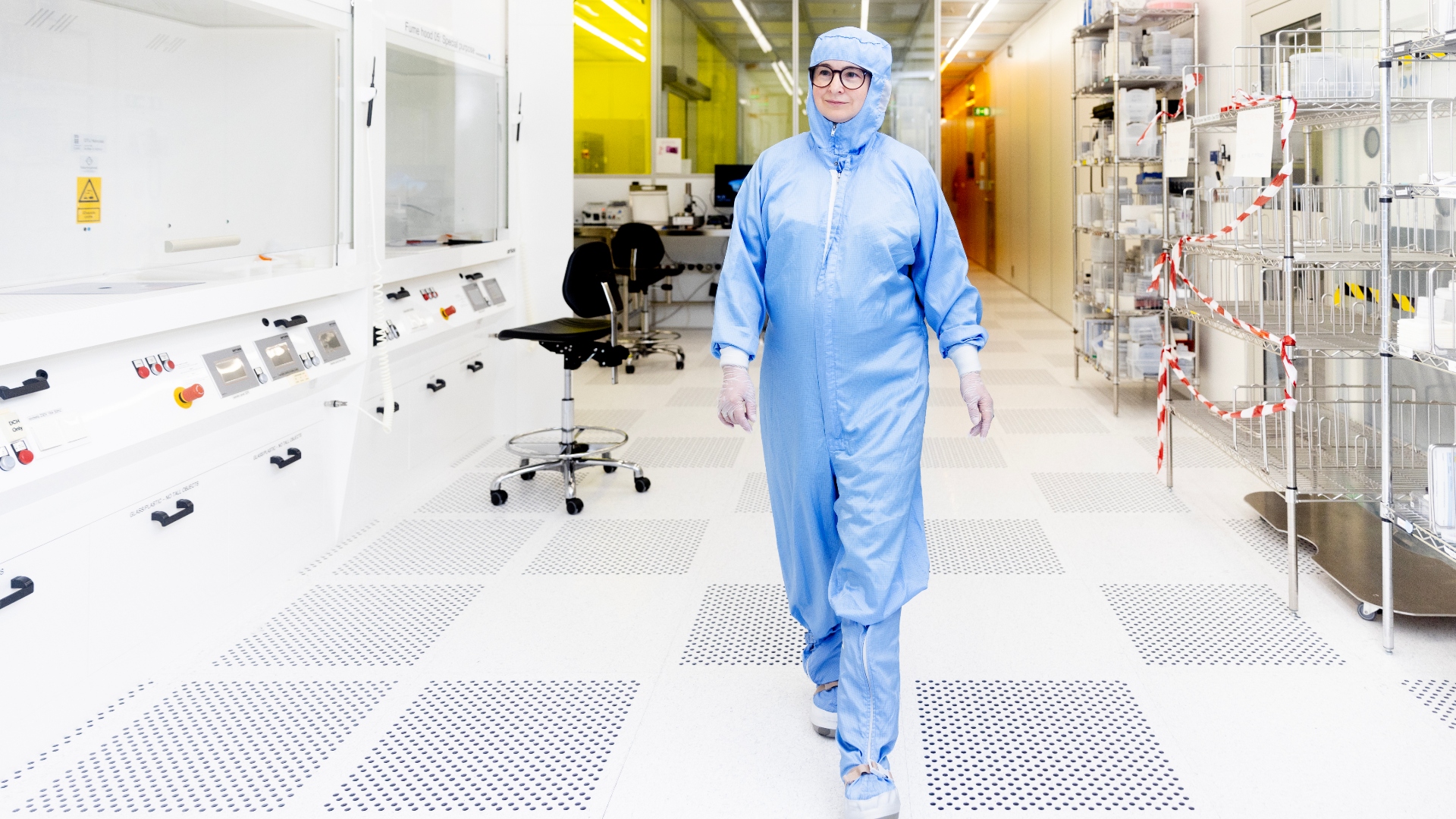
Much of Elizaveta Semenova's work takes place in DTU Nanolab's clean room. Photo: Thomas Steen Sørensen

Big things in small packages

The idea for this highly beneficial technology came to Elizaveta Semenova in 2008, when she was working as a postdoctoral researcher at a research institution in France.

At the time, her colleagues responded to her ideas with resounding silence, but today the technology's potential is widely recognized in the quantum photonics community around the world.

One such environment is DTU Nanolab, where Elizaveta Semenova and her team cultivate nanoscopic crystals with macroscopic potential. It is also here that she uses highly specialized equipment to integrate the crystals, or quantum devices, into a scalable chip. And contribute to the overall goal of developing a global core technology that can be used in applications within quantum communication, quantum computing, and quantum sensors.

Elizaveta Semenova utilizes a new technique called micro transfer printing, which uses a “type of printable stamp” to transfer the quantum devices to silicon nitride chips.

“Using this technique, we can place our quantum light sources exactly where we want to have them. This is important because the chip itself must contain a large circuit of different elements that our device must interact with,” she says.


A complex layer cake

The many different elements on the shiny silicon nitride wafer are the result of a broad European collaboration between nine different universities and companies.

Each partner contributes with its expertise, some focus on the design and fabrication of quantum devices, others on conceiving and engineering experiments, or manufacturing photonic chips, all of which are evaluated in the final stage.

Or, as Semonova's colleague, Assistant Professor Caterina Vigliar from DTU Electro, puts it:

“We are building a complex layer cake, with many different layers to perfom a variety of quantum experiments. I design the cake initially, imagining how the different flavours could combine, and I taste the layers as soon as they are being made while giving my assessment.”

In other words, Caterina Vigliar's task is to test the individual elements in an optical laboratory to ensure that the end product is as good as possible. She has now completed tests on the components that form the basis of the quantum chip - and the results are very promising.

“We are close to meeting the expectations we had for the devices' functions from the outset. So far, so good,” she says.

No one has done it before

If the quality of the final quantum chips reaches the target level, the two researchers believe it will break the boundaries of what has been possible until now.

“Getting all these components to work together with the functions and quality we are aiming for is one of the biggest challenges in modern quantum photonic technology,” says Caterina Vigliar.

She emphasizes that no one else has tried this before and believes it is because no one else has had access to the expertise that her colleague Elizaveta Semenova brings to the table.

"Her technology is a key component because the quantum dots operate at the standard frequency for telecommunications and are of very high quality. But also, because Elizaveta has figured out how to transfer them to the silicon nitride material of which the quantum chip is made of."

Caterina Vigliar returns to the layer cake analogy to elaborate on her point.

“It is great to be the chef who has the secret ingredient. But if you do not know how to add it to the layer cake, it is difficult to create a masterpiece.”
The broad collaboration began in 2023 and will run until the end of 2027.

Quantum technology

A total of nine European universities and companies are dedicated to the goal of creating a photonic quantum chip that enables applications in quantum computing, quantum communication, and quantum sensors.

These are DTU, Eindhoven University of Technology, Ligentec, Martel Innovate, Politecnico di Milano, Wroclaw University of Science and Technology, Quantum Telecommunications Italy, Tyndall National Institute, and the University of West Attica.

The collaboration is funded by Horizon Europe, the EU’s main funding program for research and innovation. It started in 2023 and will run until the end of 2027.

Contact

Elizaveta Semenova

Elizaveta Semenova Senior Researcher Department of Electrical and Photonics Engineering