Breaking the power barrier
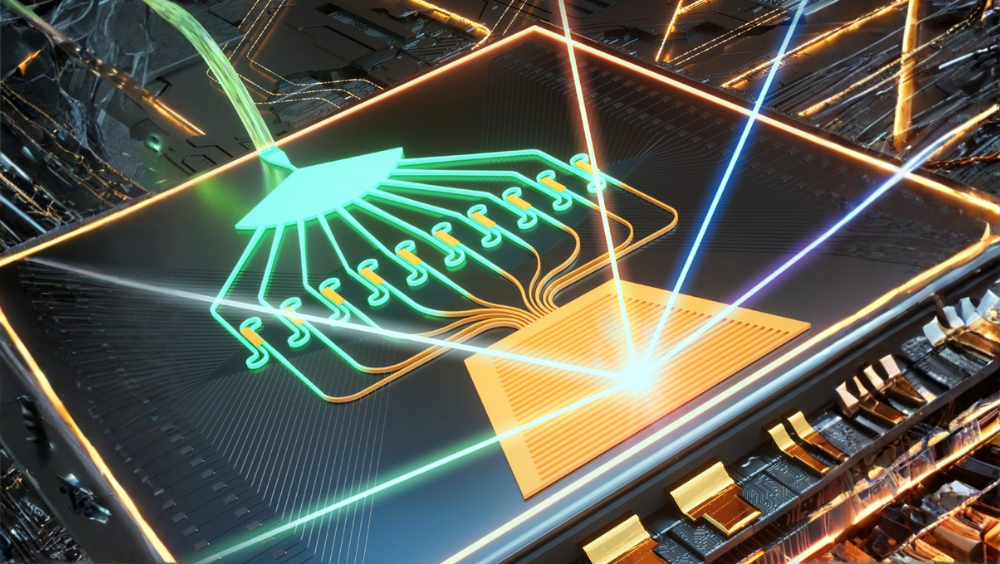
Optical phased arrays (OPAs) are remarkable devices: they steer laser beams without any moving parts, using tiny on-chip antennas that shift light in controlled ways. They’re compact, precise, and ready for the future – except for one nagging issue. Standard silicon-based OPAs simply can’t push out much light. Their output power is so low that many high-impact applications remain stuck in the “nice idea” stage.
Liu sets out to fix that. The goal is to integrate optical amplifiers directly onto the chip, turbocharging the OPA’s output by up to 100x and pushing it into the elusive watt-class regime. For context, that’s like upgrading from a flashlight to a stadium spotlight – without increasing the device’s size.
More (power) is more
- Long-range LiDAR: When you send out a light pulse to map the world, you want as much of it back as possible. With more transmitted power, a LiDAR system can detect objects farther away, deal better with bright sunlight, and scan the environment faster and more reliably. A high-power OPA essentially turns long-range LiDAR from a dream into a deliverable.
- Free-space optical communication: Satellite-to-ground links and other free-space optical communication channels suffer from atmospheric absorption, turbulence, and the occasional uninvited cloud. More optical power gives these links higher margin to survive those losses, enabling longer reach and higher data rates. In short: better Netflix in space.
- Deep-tissue bioimaging: Biological tissue scatters light like a disco ball. To see deeper, you need more power – but also precise control. A watt-class OPA promises both light that can push further into scattering tissue and beam steering sharp enough to maintain contrast and clarity. Deep imaging could finally go… well, deeper. A game changer for health technology.
A new path
Traditional silicon OPAs hit their limits due to nonlinear optical effects and thermal crosstalk – the chip starts misbehaving when you crank up the power.
At high power, nonlinear optical effects mean that silicon stops acting like a nice, predictable material. Instead, it starts doing extra “weird stuff” – absorbing more light than it should, changing its refractive index in unintended ways, and generally distorting the beam you’re trying to steer.
High optical power heats the chip, here’s where thermal crosstalk can trip up your work. When one part on the chip warms up, nearby components feel it too. Since OPAs rely on very precise phase control, even tiny temperature changes can throw them off.
So how does Liu combat this? The way forward is to combine silicon with low-loss silicon nitride and on-chip gain media through heterogeneous integration. Which is just a lot of words for a hybrid approach that keeps losses low and adds the muscle needed for watt-level output.
Lighting the way forward
Liu aims for at least 1 watt of total emitted beam power, powered by over 15 dB of on-chip gain from input to output. And this boost comes without sacrificing the OPA’s steering ability – the device is expected to maintain a steerable field of view over 180°, covering essentially everything in front of it.
If successful, a watt-class, beam-steering chip small enough to fit on your fingertip would mark a shift from lab-scale prototypes to real-world, deployable systems across sensing, communication, and imaging.
It’s a bold step toward a future where high-power optical systems are not only precise, compact, and fast – but also finally powerful enough to matter.