Floor sanding is hard work, and her husband has himself experienced health consequences from years of working with the machines. Lung damage from dust inhalation (known as woodworker's lung) and nerve damage from the shaking machine are both common results for craftsmen after years of floor sanding. This sparked a thought in Maja: Could a robot take over some of the work that puts the most strain on the floor sander's body?
This became the beginning of a project that has since developed from an idea at Kastrup Gulve into an independent robotics company, Nordic Floor Robot ApS.
“The ambition was not to invent a completely new floor sanding machine, but to develop a robot that can work together with existing professional sanding machines,” says Maja.
This way, the technology can potentially be implemented in existing workflows and become relevant for many more flooring companies.
From craft business to robot development
Maja contacted DTU Electro to get technical advice on the idea and to assess how the development could be approached.
She discussed the challenges and opportunities with Associate Professor Christian Andersen, “I explained that we could help find solutions through student projects,” he says.
This led to a collaboration with our two students Simon Jensen and Katharina Søgaard, who have just completed their master’s thesis in collaboration with Nordic Floor Robot
For the company, the collaboration has provided access to new skills and perspectives. For the students, it has also meant that their technical work has taken its starting point from a concrete industrial challenge and may end up having an impact on a physical product.
The robot needs to understand flooring
The overall idea is that the robot must first be able to understand the space it’s working in.
Using cameras, among other things, it must be able to map the floor and identify which areas need to be sanded. This requires, for example, that the robot can distinguish between wooden floors and other types of floors.
For wooden floors, it must also be able to identify the main direction of the floor – that is, how the planks or parquet are laid. This is important because the sanding must be adapted to the structure of the floor.
Next, the robot must be able to find the existing floor sanding machine and position itself correctly in relation to it.
Simon Jensen and Katharina Søgaard have worked on these very aspects in their theses. Among other things, they’ve developed solutions where a camera is used to locate the floor sanding machine and position the robot so that it can connect to the machine, and how the robot can identify the floor type and direction, using AI.
So the robot doesn’t just need to move around on a floor. It must be able to observe its surroundings, understand them and use the information to plan its work.
A working prototype
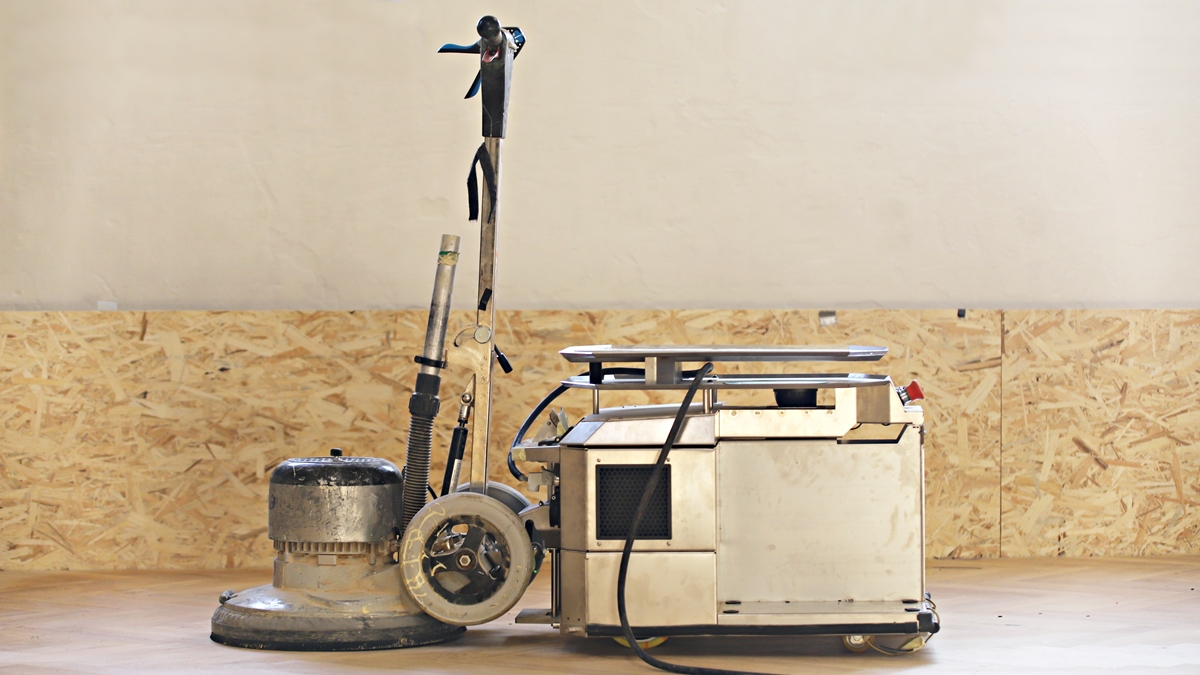
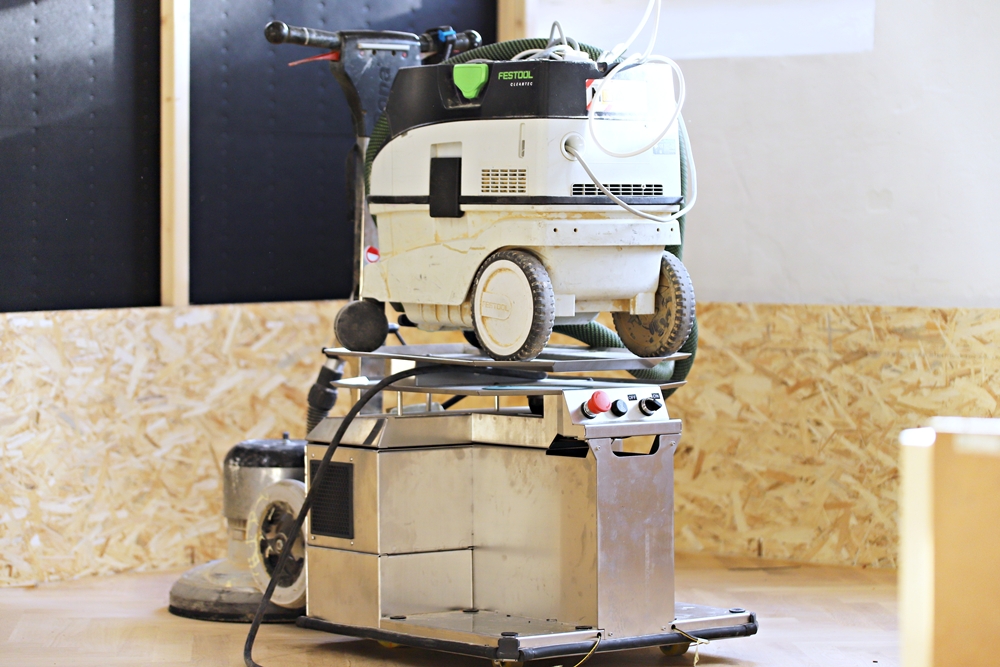
After the development work, Nordic Floor Robot now has a working prototype that can sand a floor, and in August this year, the company opened the laboratory for the first time to local companies, who could see the robot working in practice.
However, the current prototype is not fully autonomous. A professional must still be present, and the robot works together with a traditional floor sanding machine, and carries a separate vacuum as well.
But in parallel with the physical construction, the development team is working on the technologies that will make the robot more autonomous in the long term. This includes mapping, navigation and automatic connection to the sander.
The company collaborates with external engineering expertise on the mechanical and safety design as well as the integration of the necessary software.
Kastrup Gulve continues to contribute something that no laboratory test can replace: practical industry knowledge and the opportunity to test the technology in the reality where floor sanding craftsmen work every day.
Technology with a purpose
For Maja, the project is primarily about making work less physically demanding.
But the robot can also be an answer to some of the broader challenges facing the craft industry.
Labor shortages and the need for higher productivity mean that companies are increasingly having to find new ways to organize work. Here, robotics can be part of the solution – not necessarily by replacing professionals, but by taking over some of the most physically demanding tasks.
That is also the idea behind Nordic Floor Robot’s approach. The robot should not make the craftsman redundant. It should be a tool that allows the craftsman to spend less time on the hardest, physically exhausting work.
The project carries great personal importance to Maja, who hopes that the technology can create lasting change. “It’s an exciting journey from running a traditional craft business to helping develop technology that can potentially change the way we work in the industry,” she says.
The next step is to make the prototype more robust and autonomous – and in the long term to get the technology out of the laboratory and into the everyday life of flooring companies.
The ambition also extends beyond Denmark. If the robot can solve the specific challenge in practice, the goal is to develop a solution that can be used by existing flooring companies and potentially find an international market.