That’s the idea behind a new research collaboration between Senior Researcher Stela Canulescu from DTU Electro and Associate Professor Mikkel N. Schmidt from DTU Compute, who have received a Villum Synergy grant from Villum Fonden.
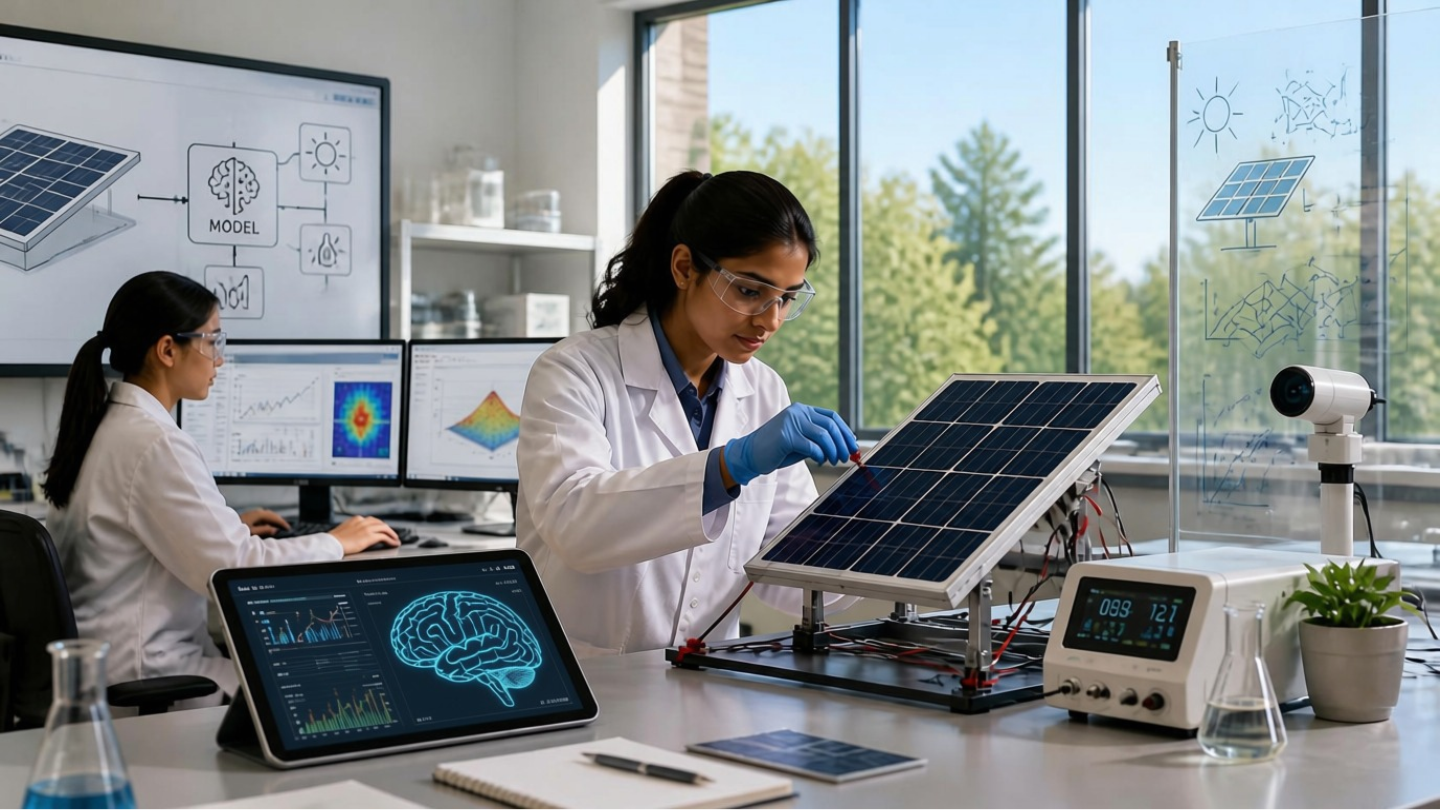
The project will combine experiments with artificial intelligence and machine learning to develop more efficient materials for next-generation solar cells, focusing on a promising class of materials known as antimony chalcogenides.
Rather than relying on trial and error alone, the researchers aim to establish a more systematic approach in which experimental results guide AI predictions, and those predictions help determine which experiments to carry out next.
Learning from every experiment
Developing new materials often involves testing many possible combinations of ingredients and production conditions. This takes time and resources, particularly when researchers have to explore a large number of possibilities before identifying a promising solution.
By bringing together experimental materials science and data-driven methods, the project aims to make that process more targeted.
The researchers will investigate how AI can help identify promising materials and manufacturing conditions, allowing them to focus their experiments where they are most likely to yield useful results. Over time, the interaction between experiments and AI could help create a research process that continuously improves its own predictions.
The ambition is not simply to use AI to analyse experimental results, but to make it an active part of deciding what researchers should test next.
Solar energy beyond conventional panels
More efficient solar cells could help expand the ways in which sunlight is converted into useful energy. The materials investigated in the project could have potential applications in two areas in particular.
One is tandem solar cells, which combine different materials to capture more of the solar spectrum and potentially convert more sunlight into electricity than a single-layer cell.
Another is indoor solar energy harvesting, where solar cells generate electricity from artificial light. This could make it possible to power small electronic devices, including those used in the Internet of Things (IoT), with less reliance on batteries.
Reducing battery use could, in turn, help limit the environmental impact associated with battery production and disposal.
These applications are longer-term perspectives for the research. The immediate goal is to understand how the materials can be developed and optimised more efficiently, and to demonstrate their potential in solar-cell applications.
A new approach to materials research
The project also explores a broader question: how can AI and experiments work together to change the way researchers develop new materials?
If successful, the approach could reduce the number of experiments needed to find suitable materials and make the development process more resource-efficient. It could also provide a model for other areas of materials science where researchers need to optimise complex production processes.
By connecting expertise in materials science at DTU Electro with machine learning at DTU Compute, the project aims to strengthen the link between experimental research and AI-driven discovery.
Ultimately, the researchers hope to demonstrate how this collaboration can make the search for better materials faster and more systematic – helping lay the groundwork for future solar technologies.