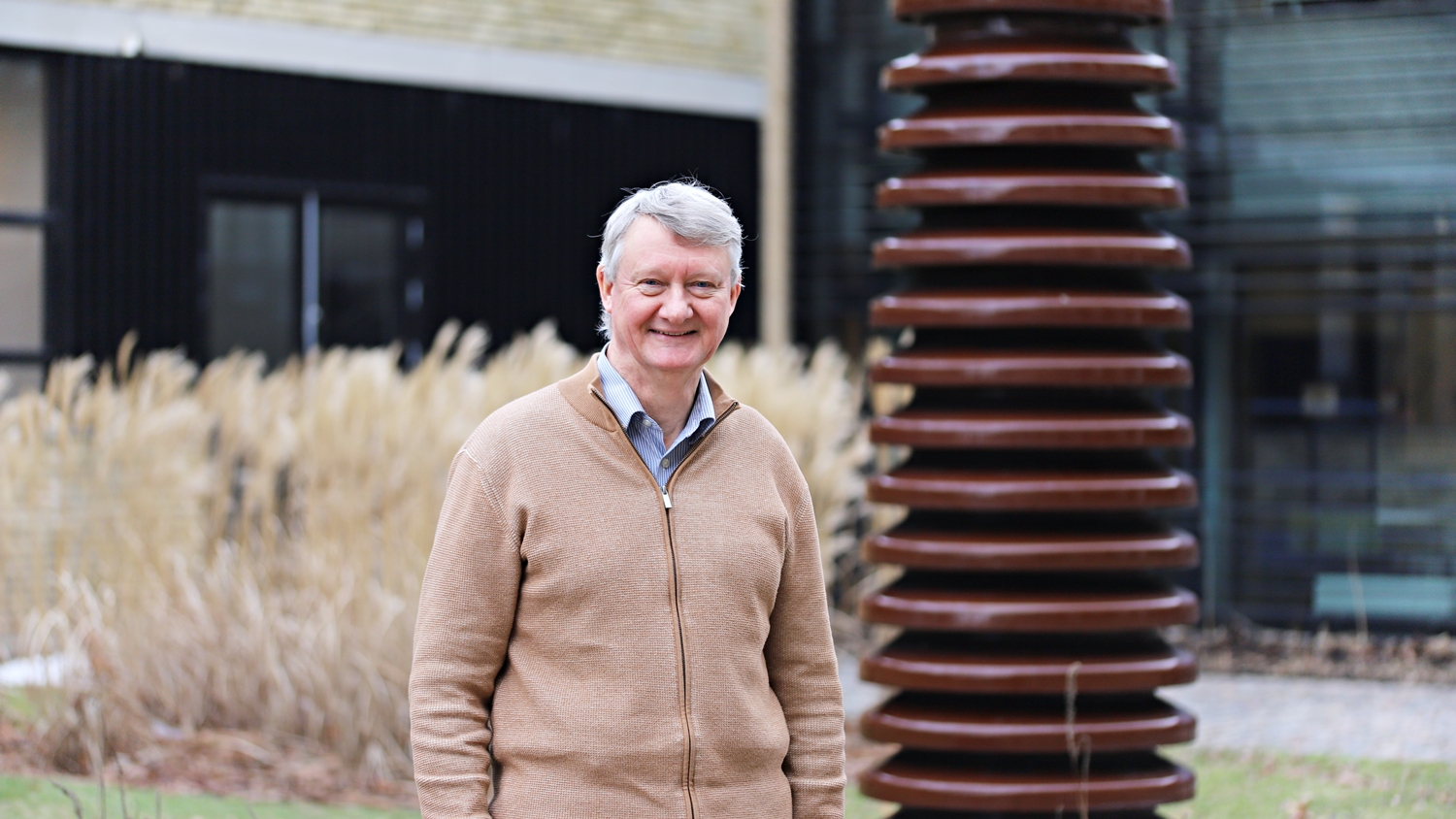
When Henrik began his studies at DTU in the summer of 1980, the institution itself was still young – only six years had passed since its inauguration.
Over the decades, he has witnessed a remarkable transformation: from a relatively small Danish technical university into an independent, internationally recognized research powerhouse.
Although many associate him closely with electrical engineering today, Henrik is in fact trained as a mechanical engineer, specialized in control technology.
He earned his PhD in 1988 and spent the following years as a postdoctoral researcher and project employee at various units before joining DTU Electro as an associate professor in 1994.
The beginning, however, was anything but smooth. Assigned to teach linear algebra alongside two more experienced colleagues, he quickly discovered that students tended to vote with their feet. As the newcomer, he saw his large auditorium gradually empty, until one day he stood before just 7 students, while the neighboring auditoriums were packed. “That was my trial by fire,” he recalls – a formative moment that, in hindsight, marked the true beginning of his journey as a teacher.
The small gestures
Teaching has always been at the heart of Henrik’s career, and looking back on the past 40 years he has met a remarkable range of students – some brilliant, some struggling, many unforgettable.
One of the first encounters that stayed with him happened just before an autumn break. A student in one of his courses was falling behind. On impulse – “back when I was still naïve,” Henrik says with a smile – he suggested that the student could sit in the room across from his office and drop by if he had questions.
The moment he closed the door, Henrik wondered what he had just signed up for. Would this mean constant interruptions? In reality, the student stopped by only once a day for a quick chat. Gradually, things began to click.
Henrik never thought he’d done anything extraordinary. But when the student graduated, he returned with two bottles of wine and a simple message: “Thank you – you got me through.” Henrik protested that he had hardly done anything at all.
The student disagreed. He had been ready to quit before that autumn break, convinced the programme was simply too difficult. Sitting across from Henrik’s office had been his final attempt – and it changed the outcome.
Henrik still thinks about him from time to time. It’s a quiet reminder that even small gestures matter. Even though Henrik feels like he’s sometimes met with trivial questions from students, he thinks “oh well, it probably helps”, and it might make the difference between giving up and moving forward.
Teaching in the age of AI
Exams, too, continue to offer moments of reflection. A few years ago, a student approached Henrik, convinced that he’d been given a wrong answer to an old exam question. Henrik reviewed the solution and arrived at the same, correct result as before. The student, however, insisted, firmly and repeatedly, that this wasn’t the correct answer.
So Henrik went through the calculation step by step with the student. The task itself was straightforward, “a fairly easy one,” as Henrik puts it, and one that any student should be able to solve correctly in order to pass. Yet the student would not budge.
Eventually, the reason emerged: the student had asked ChatGPT, which had produced a different answer. It was Henrik’s first direct encounter with students using AI tools – and doing so entirely uncritically.
The episode left a lasting impression.This was not a complex calculation and yet the student had asked a computer to do the work for him – without even questioning its answer. It revealed to Henrik a shift in how knowledge is approached by some parts of the next generation.
For Henrik, the experience became less about a single exam question and more about a broader reflection on what higher education should cultivate in an age of artificial intelligence, and where both opportunities and responsibilities lie as the technology advances.
From Legos to the real world
Asked to highlight a single defining achievement, Henrik hesitates. Much of his work, he explains, is cumulative by nature. He compares it to building a Lego tower: “The last brick is always exciting,” he says, “but it only stands because of the foundation beneath it.” And when the next brick is added, that one feels even more rewarding.
In theoretical research, there’s rarely a moment where one can point and say, that was the final result. Instead, it is an ongoing process of refinement and extension – new insights emerging as natural continuations of earlier ones.
However, when it comes to highlighting his PhD students’ work, he doesn’t hesitate.
He takes particular pride in seeing his PhD students carry theories and methods from the whiteboard into the real world. Some worked on control systems, and control of grid connections for wind turbines in collaboration with Vestas and Ørsted. Another focused on optimizing cooling systems together with Danfoss. Yet another applied advanced control strategies to wastewater treatment systems.
For Henrik, these projects represent something deeply satisfying: The moment when abstract mathematics and control theory step out of the auditorium and into turbines, power grids, and infrastructure, quietly shaping the technologies that keep society running.